ISLAM AND MATHEMATICS

Kecanggihan matematika Islam

Saat memasuki masjid, barangkali kita tidak terlalu memperhatikan berbagai ornamen yang menghiasinya. Baik di dinding, lantai atau bahkan di tempat berwudlunya.

Padahal ornamen penghias itu merupakan karya agung. Hmm, coba amati sekali lagi mosaik di dinding masjid. Sangat rumit! Dan tentu saja, juga cantik!

070621_mosaik_01.jpg

Adalah Peter Lu, seorang mahasiswa fisika dari Harvard University yang berhasil menangkap kecanggihan pola mosaik di salah satu masjid di Uzbekistan. Di mata Peter Lu, pola mosaik masjid serupa dengan pola-pola kristal.

070621_mosaik_02.jpg

Ketertarikan itu membawa Peter Lu ke karya masa lampau di Iran, yakni Darb-i Imam. Bangunan indah ini telah ada sejak 1453. Beragam pola menawan terlukis di dindingnya.

Pola-pola itu sangat menyerupai ubin penrose. Ubin penrose merupakan suatu model pengubinan karya Roger Penrose yang dibikin pada 1970-an. Fisikawan zat padat menyebutnya kuasikristal.

070621_mosaik_03.jpg

Landasan matematika untuk membuat model kuasikristal tidaklah gampang. Namun ternyata ilmuwan muslim telah mampu membuatnya. Dan itu dilakukan sekitar 500 tahun yang lampau!

Nampaknya larangan untuk mengeksploitasi tubuh manusia sebagai hiasan telah membangkitkan daya pikir ilmuwan muslim sehingga mampu menghasilkan karya brilian. Mereka mengolah pola geometris, lekukan flora, maupun kaligrafi hingga menjadi hiasan bernilai tinggi. (axireaxi on)

Islam dan Matematika

Matematika tidak hanya memiliki nilai kebenaran bukti tapi juga nilai keindahan yang agung. Saya kagum dengan ungkapan Bertrand Russel mengenai matematika: “suatu keindahan, bagai ukiran, tanpa memohon belas kasih bantuan alam, tanpa keindahan musik yang menjerat dan memikat, keindahannya murni dan agung, mampu menuju kesempurnaan, sungguh merupakan seni teragung yang pernah dimiliki oleh seni itu sendiri”.
Kemudian saya tertegun dengan komentar St Augustine, pemikir Kristen terkemuka abad pertengahan: “pemeluk Kristen yang baik dan taat harus menghindari ahli matematika. Bahaya besar telah tiba karena para ahli matematika telah mengadakan akad dengan setan untuk menggelapkan jiwa manusia dan mengurungnya dalam ikatan neraka”.
Tak kalah garang, para hakim agung Roma membuat slogan hukum: ”dalam mempelajari geometri, ilmu yang tercela dan terkutuk seperti matematika adalah HARAM hukumnya”.
Dua belas abad kemudian, Ahmad Sirhindi menjuluki ahli matematika sebagai orang idiot dan para pemujanya lebih tolol dan hina karena dia mengira bahwa matematika dan mempelajari matematika tidak ada manfaatnya untuk kehidupan manusia kelak di akhirat nanti.
Kecaman keras terhadap matematika ini terjadi pada zaman medieval yang terkenal obscure, dogmatic dan irrasional. George Sarton membagi History of Science dalam beberapa zaman, setiap zaman berasosiasi pada seorang pemikir ternama, dan berakhir pada setiap setengah abad. Dari 450 BC sampai 400 BC adalah era Plato, dari 400 sampai 350 BC adalah era Aristotle dan seterusnya.
750 M sampai 1100 M adalah merupakan zaman dimana dalam kurun 350 tahun secara keseluruhan peradaban dan ilmu didominasi oleh dunia Islam, zaman yang tak terkalahkan secara berturut-turut muncul nama-nama dari Jabir, al-Khawarizmi, ar-Razi, al-Mas’udi, al-Wafa, al-Biruni dan Umar Khayyam. Dan hanya setelah abad ke-11 M barulah muncul nama-nama seperti Gerard dan Roger Bacon. Tapi kehormatan atas ilmu masih disandang ulama-ulama Muslim dalam kurun dua abad berikutnya yaitu Ibn Rushd, Nashiruddin at Thusi dan Ibnu Nafis.
Namun setelah 1350 M umat Islam tenggelam dalam samudra dogmatis yang hanya menelurkan beberapa ilmuwan handal pada abad 15 M.
Sejarah mengungkapkan fakta bahwa scientific brilliance selalu dibarengi dengan perkembangan matematika. Pada kenyataanya penemuan-penemuan matematik telah memuluskan jalan menuju kemajuan spektakuler dalam sejarah ilmu dan teknologi. Tidak ada satu negarapun yang pernah mencapai kesuksesannya tanpa penguasaan matematika. Ketika umat Islam mendominasi dunia sains, mereka sangat hebat dalam matematika.
Musa al khawarizmi (780-850 M) merupakan salah satu dari scientific minds of Islam, yang mempunyai pengaruh dalam pemikiran matematika lebih dari ilmuwan abad pertengahan manapun. Dia tidak hanya menyusun buku aritmetika namun juga tabel-tabel astronomi. Magnum opusnya hisab al jabr wa-l-muqabalah telah diterjemahkan kedalam bahasa latin dan digunakan selama empat abad sebagai buku panduan utama dalam mata kuliah aljabar di universitas-universitas terkemuka di seluruh Eropa.
Dengan mengenalkan jumlah yang tidak diketahui kemudian menemukannya, aljabar menjadi the open-sesame untuk berbagai penemuan; the be-all dan end-all dari semua ilmu sains.
Penyair ternama; dan juga ahli matematika yang handal Omar Khayyam (1048-1122 M) dan Nashiruddin at Thusi (1201-1274 M) menunjukkan bahwa setiap besaran rasio, yang sepadan maupun tidak, adalah bilangan, rasional maupun irrasional. Dan teori tersebut kemudian secara pelan dan lambat menuju kesempurnaannya disaat bermulanya zaman renaissance di Eropa.
Iqbal, pemikir kenamaan asal Pakistan memuji at Thusi Karena telah melontarkan pertanyaan terhadap the uclidean postulate atas pararelism. Omar khayyam merupakan ilmuwan pertama yang membuktikan bilangan dari teori non-euclidean geometry yang nantinya ditemukan oleh Lobchersky, Riemann dan Gauss secara terpisah selama pertengahan abad 19 M.
Omar Khayyam telah mendahului sejak 7 abad sebelum mereka, yang mana dikemudian hari, Einstein menggunakan the non-euclidean geometry untuk mengantarkannya pada “dunia baru” dalam bidang sains. Tidak ada petunjuk dan rumusan yang tidak dipecahkan oleh Umar Khayyam. Beliau juga mulai menggunakan grafik untuk mengkombinasi aljabar dan geometri untuk membuktikan persamaan kubik.
Pasti akan selalu diingat bahwasanya seorang jenius bernama Descartes yang kemudian memperagakan the tour de force dari kombinasi aljabar dan geometri, bersamaan dengan penemuan filsafat barunya dengan diktumnya yang terkenal: “cogito ergo sum”.
Belum ada lagi pemikir dunia Muslim yang mengikuti jejak Umar Khayyam dan menguatkan rasionalism, karena Imam Ghazali telah “terlanjur” menulis tahafutul falasifah. Memang, Ibnu Rushd kemudian juga menulis tahafut tahafut. Namun sayangnya dunia Muslim menolaknya, sebaliknya orang Eropa berebut mengambilnya. Orang Eropa menjadi averoist; pengikut setia Ibn Rushd.
Al Biruni sukses dengan the idea of function, yang mana menurut Spengler, adalah simbol barat yang mana tidak ada peradaban lain yang bisa memberikannya walaupun hanya sekedar petunjuk dan gambaran. The idea of function yang dilontarkan al-Biruni mengenalkan konsep inter-dependence dan movement, melihat dunia sebagai sebuah kumpulan proses inter-dependence.
Konsep ini merupakan konsep dialektik. Namun lagi-lagi disayangkan bahwa umat Islam tidak bisa mengembangkan embrio yang brilliant tersebut, dan akhirnya konsep tersebut berhibernasi selama berabad-abad karena umat Islam terbuai dalam lantunan ninabobo dogmatism dan irrationalism. Embrio tersebut baru muncul dan lahir kembali tatkala tersentuh oleh peradaban barat, sungguh ironis. Ide yang dinamis tidak akan pernah maju dalam lingkungan masyarakat yang statis!.
Akhirnya pada abad ke 17 M secara tragis namun desisif , supremasi sains berputar “melawan” dunia Muslim, sungguh sayang……..
Geometri Descartes diterbitkan pada tahun 1637 M. Ahmad Sirhindi meninggal pada tahun 1624 M, namun dia sudah terlanjur mengutuk matematika dengan ungkapan yang tegas dan lugas. Dengan mengecam matematika, kita telah melangkah jauh keluar dari parade barisan ilmu sains dan teknologi.
Seperdelapan dari ayat-ayat al-qur’an menekankan tadabbur, tafakkur dan ta’aqqul. Implikasinya adalah bahwasanya al-quran menjunjung tinggi supremasi akal. Tatkala kita menolak akal dengan mudah kita akan menjadi korban obscurantism dan dogmatism. Worldview kita masih medieval. Islam telah menjalani transformasi dari revolusi aljabar menuju stagnasi aritmetik.
Tidak akan pernah berkembang matematika dan ilmu sains serta teknologi kecuali apabila dan hingga weltanshauung (worldview, red.) kita telah bersandar pada asas tafakkur tadabbur dan menjadikan ta’aqqul sebagai penjaga “pintu masuk” dunia Islam.
Islam bukanlah sistem yang tertutup sebagaimana pandangan kaum orthodox. Karena hal tersebut malah akan mencoreng citra Islam sebagai agama yang universal “rahmatan lil ‘alamin”. Islam adalah keimanan dimana Tuhan menyediakan manusia sesuatu yang baru, pada tiap paginya, “sarapan” yang bisa menjadi problem solving bagi berbagai permasalah-permasalahan baru yang muncul saat itu.
Sebagaimana yang telah tertera dalam al-quran, setiap masa memiliki kemuliaanya. Dan pada akhirnya, Islam telah menghubungkan dirinya kepada keagungan Tuhan dan diakhir yang lain kepada diversity of humankind (keberagaman manusia). Disini, pluralisme adalah merupakan kekuatan dinamisnya. Wallahu a’lam. For our next scientists; where are thou!(albi)

Islam's Contributions to Civilization: Mathematics

I've been very disheartened to hear people, both here and elsewhere, regard the Islamic world as if it were a barbarous place devoid of any redeeming value. To go some ways toward showing just how false that view is I thought I might start writing a series of diaries on the many great advances that the world owes to these "cave dwelling barbarians."

It is fitting in a way to start the series with mathematics because math is not an end unto itself but rather a means by which to accomplish so much else. It is the base of science and economics which means it is the foundation on which US society was built.

So how has Islam contributed to mathematics? First let me say that I am not literally here talking of Islam the religion. Rather I am speaking of the region and cultures which either preceeded and led up to, or postdated and developed within the area where Islam grew to power. This essentially means the arabs and persians in the time period shortly before Muhammed to current day. For example the earliest mathematical texts yet found came from Egypt, Mesopotamia, and India but at ~1300BC these too far predate Islam for us to tie them directly to the culture (as opposed to religion) of Islam. For Islam's contributions we have to look much later.

Roman Numerals

The Roman notation of numbers (I, II, III, IV, V, VI...) was used in Europe commonly into the 1400s. This system originally developed from simple tally sticks. The system worked (clumsily) for basic addition but was difficult for anything more complicated. The reasons for this are varied.

In the case of fractions a new symbol was used for each fractional value. This meant that only a very few commonly used fractions were ever codified. For instance 1/12 had a symbol but you can bet that 1/137th didn't.

Subtraction, multiplication, and division with Roman numerals is so complicated that it is virtually always done with the use of a special abacus.

The Romans and later Europeans had the concept of "zero" but did not treat it as a number in and of itself (with a few very rare exceptions). The Roman systems of numbers had no symbol for zero and so a number of very important mathematical ideas remained unassailable, not the least of which is negative numbers (if you have no zero you don't think of what's on the other side).

Arabic Numerals

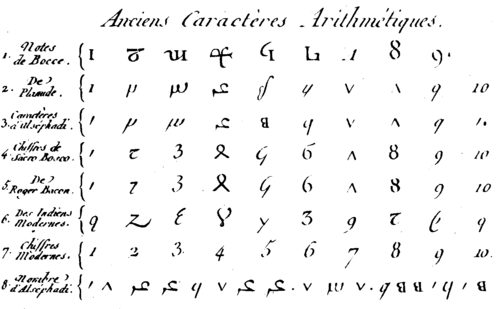
Arabic numerals are not strictly speaking arabic. They originate in India around 300BC. They are referred to as "Arabic" because it was the work of arab mathematicians that really spread the use of these symbols and made them pretty universal from the Indian subcontinent through the Middle East eventually into Europe. Furthermore the arabs made a significant advancement of making zero a number unto itself in the 800s AD.

While they would look strange to us these symbols morphed over time to become the number system we all grew up with (1, 2, 3, 4...).

This system of numbers was much more capable than the Roman version. It was more compact in general (compare 58 to LVIII or 1997 to MCMXCVII). The Roman system requires very careful reading since some numbers are subtractive and some additive based on position (IV is 4 but VI is 6), by comparison the Arabic numbers are all "additive" or all subtractive (if used in conjunction with a negative sign). Addition and subtraction are simple, enough so that any school age child is expected to routinely do them. Multiplication and division are only a little more complicated.

Very large numbers and very small numbers can be a bit cumbersome (but not nearly so cumbersome as in Roman Numerals) but this was eventually relieved with the use of Exponential or Scientific notation (i.e. 450,000,000,000 is written 4.5x10^11 or 4.5E11). Interestingly enough I can't seem to find any info on where/when scientific notation originated. I'm assuming it is European but may be wrong.

Ultimately it boils down to the Arabic system being open (in the sense of continuously expandable) and the Roman system being closed (as in it had finite discrete states and to go outside of that required the creation of new symbols). This is somewhat analagous to the difference between a lettered language and logographic systems, like Kanji, where every symbol is a single word. In the former system it is easy to continuously expand the vocabulary in the latter each new term requires a totally new symbol and the language quickly becomes unwieldy and potentially incomprehensible.

It is no coincidence that calculus developed first among those using the arabic system and only really started developing in Europe after the adotion of same. The impact of this contribution to mathematics can't be overstated. Without calculus most of science is simply impossible.

Beyond the numbers

Okay so the Arabic number system was a big improvement, one which the arabs made significant contributions to if not actually originating themselves. What else have they got?

Oh boy.

Our very word "algebra" is derived from Al-Jabr wa-al-Muqabilah, a treatise on mathematics by Muhammad ibn Mūsā al-Kwārizmī from whom we also get the word "algorithm." Al-Kwarizmi, a persian, is considered "the father of modern algebra" and algebra of course is one of the most fundamental building blocks of mathematics.

Al-Biruni by age 27 had written nine books and a host of shorter works. Much of this work had to do with the application of geometry to both astronomy and geography. Today a crater on the moon is named in his honor.

The poet Omar Khayyam created a geometic solution to cubic equations (ax^3 + bx^2 + cx +d =0), a feat that is regarded as "one of the most original discoveries in Islamic mathematics" (no small feat clearly). He also contributed to the synthesis of mathematical approaches (combining trigonometry and approximation theory to provide solutions to other algebraic problems).

The greatest contribution to the Ptolemaic planetary system (our understanding of the motion of the planets including our own) until the coming of Copernicus was made by the Persian Nasir al-Din al-Tusi due to his work on spherical trigonometry.

Ghiyath al-Kashi was considered the inventor of decimal fractions (1.16 as opposed to 29/25ths) because his contribution to the field was so enormous (he did not actually invent them). He furthermore computed pi to the 16th decimal place. What's more he developed an algorithm for calculating nth roots and put together tables of sines accurate to 8 decimal places (for use in astronomy).

The hindu-arabic number system was originally desgined for "dust boards," basically primitive chalk boards. Abu'l-Hasan al-Uqlidisi modified the system to make it usable for the much more convenient (and potentially permanent) method of pen and paper. While this sounds minor consider the awesome potential of being able to write a mathematical work and include directly in it the very mathematical symbols to which you refer. Quite simply without this development the very idea of math text is impossible. Each problem would be described in words while the reader would have to write out the equation in numbers on their personal dust board.

The list of somewhat less titanic but still very important Islamic mathematicians and the fields they contributed to is long; Thabit ibn Qurra (geometry), Abu Kamil (algebra, irrational numbers), Al-Batanni (trigonometry), Sinan ibn Thabit (geometry), Ibrahim ibn Sinan (calculus), Abul Wáfa (invented the tangent function, trigonometry), Abu Bakr al-Karaji (numerical analysis, major advancements to algebra), Al-Haytham (number theory), Abu Nasr Mansur (discovered sine law, trigonometry), Abu Sahl al-Kuhi (geometry), Al-Baghdadi (arabic decimal system), Al-Samawal (algebra), Sharaf al-Din al-Tusi (founded algebraic geometry), Al-Farisi (number theory), Ulugh Beg (trigonometry in his spare time from ruling the Timurid Empire).

The Mathematical Legacy of Islam

Devlin's Angle

Today, mention of the word Islam conjurs up images of fanatical terrorists flying jet airplanes full of people into buildings full of even more people, all in the name, they say, of their god. In an equally sad vein, the word Baghdad brings to mind the unscrupulous and decidedly evil dictator Saddam Hussein. Both images are as unrepresentative as they are understandable, a sad reflection on the ease with which a handful of crazed fanatics, lacking the ability or the wit to bring about change by peaceful means, can hijack not just a plane or a country but an entire cultural heritage and its associated religion. For those of us in mathematics, and by extension all scientists and engineers, the sadness is even greater. For the culture that these fanatics claim to represent when they set about trying to destroy the modern world of science and technology was in fact the cradle in which that tradition was nurtured. As mathematicians, we are all children of Islam.

Following the advent of Islam in the seventh century, Islamic forces attacked and conquered all of North Africa, most of the middle East, and even parts of Western Europe, most notably Spain. The capital of this empire, Baghdad, was established on the Tigris River. Its location made it a natural crossroads, the place where East and West could meet. Baghdad quickly became a major cultural center.

With the emergence of a new dynasty, the Abbasids, in the middle of the eighth century, the Islamic Empire started to settle down politically, and conditions emerged in which mathematics and science could be pursued. By and large, the early mathematical work done by Arabic scholars was predominantly practical, and not very deep -- certainly nothing like the mathematics of the ancient Greeks a thousand years earlier. Nevertheless, the subject appears to have been viewed as important and prestigious. Early Islamic scholars imported to Baghdad books on astronomy and mathematics from India.

Early in the ninth century, the Abbasid caliphs decided to adopt a more deliberate approach to the cultural and intellectual growth of the empire. They established the House of Wisdom, a sort of ninth century academy of science, and started to gather together scholarly manuscripts in Greek and Sanskrit, together with scholars who could read and understand them. Over the following years, many important Greek and Indian mathematical books were translated and studied, leading to a new era of scientific and mathematical creativity that was to last until the 14th century.

One of the first Greek texts to be translated was Euclid's Elements. This had a huge impact, and from then on the Arabic mathematicians adopted a very Greek approach to their mathematics, formulating theorems precisely and proving them formally in Euclid's style. Like Greek mathematics, which was defined more by the common language in which it was written and carried out, rather than the nationality of the practitioners, Arabic mathematics was determined largely by the common use of Arabic by scholars of many nationalities, not all of them Arabic or Muslim, spread throughout the Islamic Empire.

One of the earliest and most distinguished of the Arabic mathematicians was the ninth century scholar Abu Ja'far Mohammed ibn Musa Al-Khwarizmi, who was an astronomer to the caliph at Baghdad. His name indicates that he was from the town of Khwarizm (now Khiva), on the Amu Darya river, south of the Aral Sea in what is now Uzbekistan. (Khwarizm was part of the Silk Route, a major trading pathway between Europe and the East.) Al-Khwarizmi's full name can be translated as "Father of Ja'far, Mohammed, son of Moses, native of the town of Al-Khwarizmi".

Al-Khwarizmi wrote several books that were to be enormously influential. In particular, his book describing how to write numbers and compute with them using the place-value decimal system that came out of India would, when translated into Latin three hundred years later, prove to be a major source for Europeans who wanted to learn the new system.

In fact, Al-Khwarizmi's book on arithmetic with the Hindu-Arabic numbers was so important, it appears to have been translated several times. Many translations began with the phrase "dixit Algorismi" ("so says Al-Khwarizmi"), a practice that led to the adoption in medieval times of the term algorism to refer to the process of computing with the Hindu-Arabic numerals. Our modern word "algorithm" is an obvious derivation from that term.

Another of Al-Khwarizmi's manuscripts was called Kitab al jabr w'al-muqabala, which translates roughly as "restoration and compensation". The book is essentially an algebra text. It starts off with a discussion of quadratic equations, then goes on to some practical geometry, followed by simple linear equations, and ending with a long section on how to apply mathematics to solve inheritance problems. The Englishman Robert of Chester translated Al-Khwarizmi's algebra book from Arabic into Latin in 1145. The part dealing with quadratic equations eventually became famous. Such was the influence of this work that the Arabic phrase al jabr in the book's title gave rise to our modern word "algebra".

After Al-Khwarizmi, algebra became an important part of Arabic mathematics. Arabic mathematicians learned to manipulate polynomials, to solve certain algebraic equations, and more. For modern readers, used to thinking of algebra as the manipulation of symbols, it is important to realize that the Arabic mathematicians did not use symbols at all. Everything was done in words.

One of the most famous Arabic mathematicians was 'Umar Al-Khayammi, known in the West as Omar Khayyam, who lived approximately from 1048 to 1131. Although remembered today primarily as a poet, in his time he was also famous as a mathematician, scientist, and philosopher, doing major work in all those fields.

It was largely through translations of the Arabic texts into Latin that western Europe, freshly emerged from the Dark Ages, kick-started its mathematics in the tenth and subsequent centuries.

It was around the tenth century that "cathedral schools" sprang up in many parts of Europe,. Designed to train clerics, they concentrated on the trivium (grammar, logic, and rhetoric), with more advanced students going on to the quadrivium (arithmetic, geometry, music, and astronomy). Their creation helped spur an increased interest in mathematics. To fuel that interest, scholars turned to the ancient works preserved by the Islamic culture, many of them in Spain. For instance, Gerbert d'Aurillac (945-1003), later to be Pope Sylvester II, visited Spain to learn mathematics, then returned to France where he reorganized the cathedral school in Rhiems. He re-introduced the study of arithmetic and geometry, taught students how to use the counting board, and even used Hindu-Arabic numerals -- though apparently not the full place-value system we use today.

In the centuries that followed, many European scholars spent time in Spain translating Arabic treatises on various subjects. Latin was the language of the European scholars, and thus the target language for the translations. Since few European scholar knew Arabic, however, the translation was often done in two stages, with a Jewish scholar living in Spain translating from the Arabic to some common language and the visiting scholar then translating from that language into Latin. In the same way, many ancient Greek texts, from Aristotle to Euclid, were also translated into Latin, whereupon they began to make an impact in the West.

In addition to the translations of Al-Khwarizmi's works, of particular note was the appearance in 1202 of Fibonacci's book Liber abaci, which described the Hindu-Arabic place-value system for representing numbers, and explained how to compute with them. Fibonacci's treatment was so good that it arguably had more influence than any other source on the eventual acceptance of the new number system around the world, including Al-Khwarizmi's writings that had come much earlier.

The full story of Fibonacci is a fascinating one, which I will turn to in a future column. The point I want to make now is that it was through translations of the Arabic texts that western Europe was able to develop its own mathematical traditions so rapidly, paving the way for the scientific revolution in the seventeenth century and thence to the scientific and technological world we take for granted today. Many of those Arabic texts were themselves translations of still earlier Greek works from a thousand years earlier.

Without the dedication and commitment to science of the Islamic scholars of the 9th to the 14th century, who both preserved important scientific works and pushed forward the limits of mathematical and scientific knowledge, it is not at all clear that Western Europe would have become the world leader in science and technology. And had that not been the case, it is unlikely that the United States (as we know it today) would have inherited that leadership role.

I suspect that Osama bin Laden, as an educated man from a very wealthy family, is fully aware of the crucial role played by Islam in the development of the West's scientific tradition. I doubt that the same is true for the hordes who pour out into the streets of Iraq and Pakistan in his support, to rejoice the slaughter of men, women, and children they have never met, living in countries they have never visited. I doubt also that a sense of Islam's ancient tradition of scientific scholarship and learning is possessed by the fanatical few who, at bin Laden's bidding, believe that the surest way to achieve immortal greatness in the eyes of their god is to commit mass murder as a first step towards turning back the advances in science and technology that they see as so evil, and returning humankind to the Stone Age.

Ignorance, we used to say, is bliss. Maybe that was once the case, although I very much doubt it. Be that as it may, I think that the clear message of September 11 and the events that have unfolded in the months since then, is that ignorance is dangerous, leaving the gullible ignorant wide open to manipulation by unscrupulous and evil individuals. It is also, as I have tried to indicate, deeply sad.